King of Cups — tarot card meaning
Minor Arcana
King of Cups
The King of Cups is about emotional maturity: a capacity to feel and still not hand the wheel to a first reaction. Emotional steadiness, responsibility for how emotion is expressed, a calm presence alongside another person’s emotions.
The card is often reduced to a man, a husband, a psychologist, or “the cold one.” It is more accurate to look at the skill: to be in a feeling and choose what to do with it. The card does not assign a person’s gender. It is about self-command in how emotion is expressed, not about an absence of heart.
General meaning
In a spread, the King describes someone who knows how to hold an emotional storm — their own or another’s — without denying the wave. You can comfort, decide, not explode, not drown. This is not suppression. It is an adult way of handling emotion.
The weak point is control to the point of numbness, or manipulation by calm. Neighboring cards will show whether this is genuine maturity or a mask of being above it. The King itself notes responsibility for the climate you create with your reactions.
Upright
Upright more often speaks of emotional steadiness without coldness. A person feels and chooses a form: the tone of a conversation, the moment, a boundary, support. Others are calmer nearby not because they are forbidden a feeling, but because someone stays steady.
The upright King supports maturity in love, conflict, care, leading people. If the question is whether this person can be leaned on emotionally, the card describes the ability to stay steady under emotional pressure — not a promise that they are always right.
Reversed
The reversed King often loses balance. Suppressed anger, passive aggression, emotional control, an outburst after a long performance of calm, a withdrawal into dependence so as not to feel. Or, on the contrary, a demonstrative coldness as power.
This is not a caricature of an emotional tyrant. A person can simply be overloaded and without the skill of staying steady. The reversed card asks where unexpressed emotion goes — into the body, into passive-aggressive politeness, into a snap.
Love and relationships
In love, upright can describe a partnership in which there is both warmth and self-possession: a person does not disappear into drama and does not devalue a feeling. A readiness to stay present when things are difficult without becoming a judge. This is not a portrait of a husband and not a guarantee of an ideal pair.
The reversed card shows using calmness as a form of control, unavailability, a demand not to make a scene, outbursts that are denied the next day. Look at whether you can be alive with this person — or only careful emotions are allowed. Maturity is not equal to a ban on tears.
Work and career
At work the King of Cups is strong in roles that require managing both people and difficult decisions: conflict, a client, a team under stress. Upright can describe emotionally steady leadership, ethics, responsibility for the emotional tone in which a difficult situation is handled.
The reversed card notes a manager or a specialist who presses with politeness, cannot stand other people’s emotions, or snaps when the mask falls. The card does not promise a new position. It is useful to ask whether your composure serves the work and the people — or only the image of being unbending.
Money and finances
In money questions the King is more about calm decisions, not impulsive spending or panic-driven saving. Upright can describe a capacity not to take financial steps at a peak of hurt or euphoria.
The card does not give investment advice and does not promise wealth. Reversed more often shows decisions from hidden anger, revenge, a need to buy dignity. It is worth waiting until the wave falls — maturity here is in the pause between a feeling and a signature.
Advice
Allow yourself to feel, and separately choose how to express it. Maturity does not mean being unmoved. The point is that emotion should not control you or everyone around you.
If you are the person who helps steady the emotional atmosphere for others, check whether you yourself have a place for feeling. Otherwise calm becomes a dam that will one day break.
Symbolism
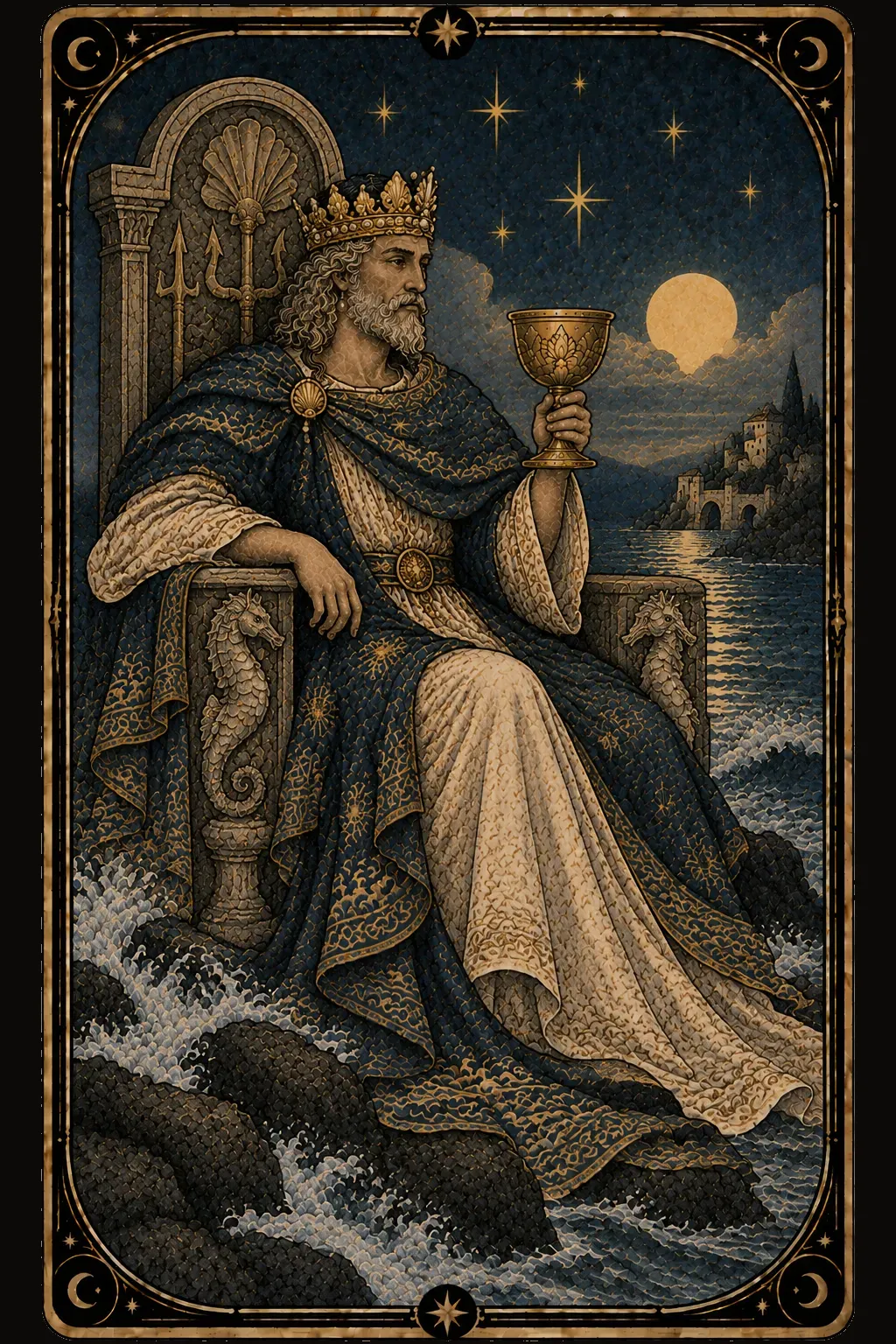
In the classical Rider–Waite image, a seated figure occupies a throne set among water, holding a cup and a scepter. A ship appears in the background. A fish is visible as a pendant or motif.
Tradition links this scene with a power that is not afraid of strong feeling and does not let it wash the throne away. The traditional image explains the theme of emotional composure. It does not claim that the TARORIA card copies Rider–Waite. In a reading, stability amid feeling matters more than the ship as a prediction of a path.
Combinations with other cards
Next to the Emperor, the King of Cups joins structure and feeling: order does not have to be dry, and warmth does not have to be chaotic. With Temperance, emotional steadiness becomes gentler and more measured: less suppression, more measured responses. With Justice, responsibility for words and tone comes to the front — what is said has weight.
Neighboring cards show whether this is maturity or a mask. How to express a feeling is the person’s decision, not the card’s title.
Frequently asked questions
Does the King of Cups mean a man or a partner?
No, not automatically. It is emotional maturity: to feel and choose a reaction. The card does not assign gender or a husband’s role. Look at who in the question stays steady — and whether calm is replacing cold.
Is this a cold person?
Not necessarily. Upright more often speaks of emotional steadiness with a living feeling. Cold appears when maturity is confused with a ban on emotions — especially reversed. The difference is whether you can be alive nearby.
How is the King different from the Queen of Cups?
The Queen is depth and receptivity, attention to an inner climate. The King is responsibility for expression and for the climate that reactions create. One person can show both qualities. In a spread, look at the accent: to feel nuance, or to hold the tone.
What does the reversed King of Cups show?
Often a loss of emotional steadiness: suppressed anger, passive aggression, using calmness as control, an outburst after a mask of calm, a withdrawal from feeling into dependence. Not necessarily a villain. Ask where unexpressed emotion goes.