Two of Wands — tarot card meaning
Minor Arcana
Two of Wands
The Two of Wands begins with something already established and asks what comes next. This is not a spark from nothing. It is a choice of direction: where to develop what has begun, which possibility to test next, and what the next step should be so you are not moving blind.
People reduce it to “a plan for the future.” More precisely, it is a crossroads. The world is wider than the current point, and a person is deciding whether to step beyond familiar territory.
General meaning
This is a strategic pause, not a freeze of fear. Something already works, and a larger view is available. The real question is which direction to take, and whether it is too soon to leave what is already working.
Nearby cards clarify the size of the choice: a move, a change of role, expanding a venture, a different tone in a relationship. The Two looks beyond what has already been reached. It does not tell you to abandon everything.
Upright
Upright, the survey is usually mature. A person is not thrashing. They compare options, keep hold of what has already been done, and consider how far to expand. You can plan without discarding the present.
If the question is “what next,” the card more often says a direction needs choosing than it promises that every way forward will work out.
Reversed
Reversed, the view ahead often fails. A person may stay stuck at the current point and refuse to look farther. Or there are too many plans, and none becomes a step. Sometimes the fear of losing what has already been reached is stronger than interest in growth.
Staying is not forbidden. The useful question is whether a direction has actually been chosen, or whether you are standing with a map of the world and still have not taken the first step.
Love and relationships
In love, upright can describe a conversation about the future: where the connection is going, whether to meet more often, make shared plans, change the rhythm. That is not a wedding forecast.
Reversed, one or both people may refuse to look beyond current convenience, or their expectations about the future may have drifted apart. Ask whether there is a shared horizon, or whether each person is holding a different map and no common direction exists between you.
Work and career
At work this is often a choice between what is stable and what could expand: another market, role, format, or location. Upright can describe planning after a first success.
It does not promise a new position. Reversed, the fear of stepping outside the current frame, or too many competing ideas without a decision. Name what you want to keep as your foundation, and which one direction you will test next.
Money and finances
In money questions the Two is about distributing what is already there: where to direct resources without scattering them. Upright is not profit from some imagined wider world.
This is not investment advice. Reversed, a person may cling to one source out of fear, or spread themselves across too many directions. Compare two or three real paths rather than keeping an endless horizon in your head.
Advice
Separate what you already have from where you want to grow. Choose one horizon for the next stretch of time, not all of them at once.
Planning here is not a substitute for a step. After looking into the distance, you need a concrete direction, or the map remains only decoration.
Symbolism
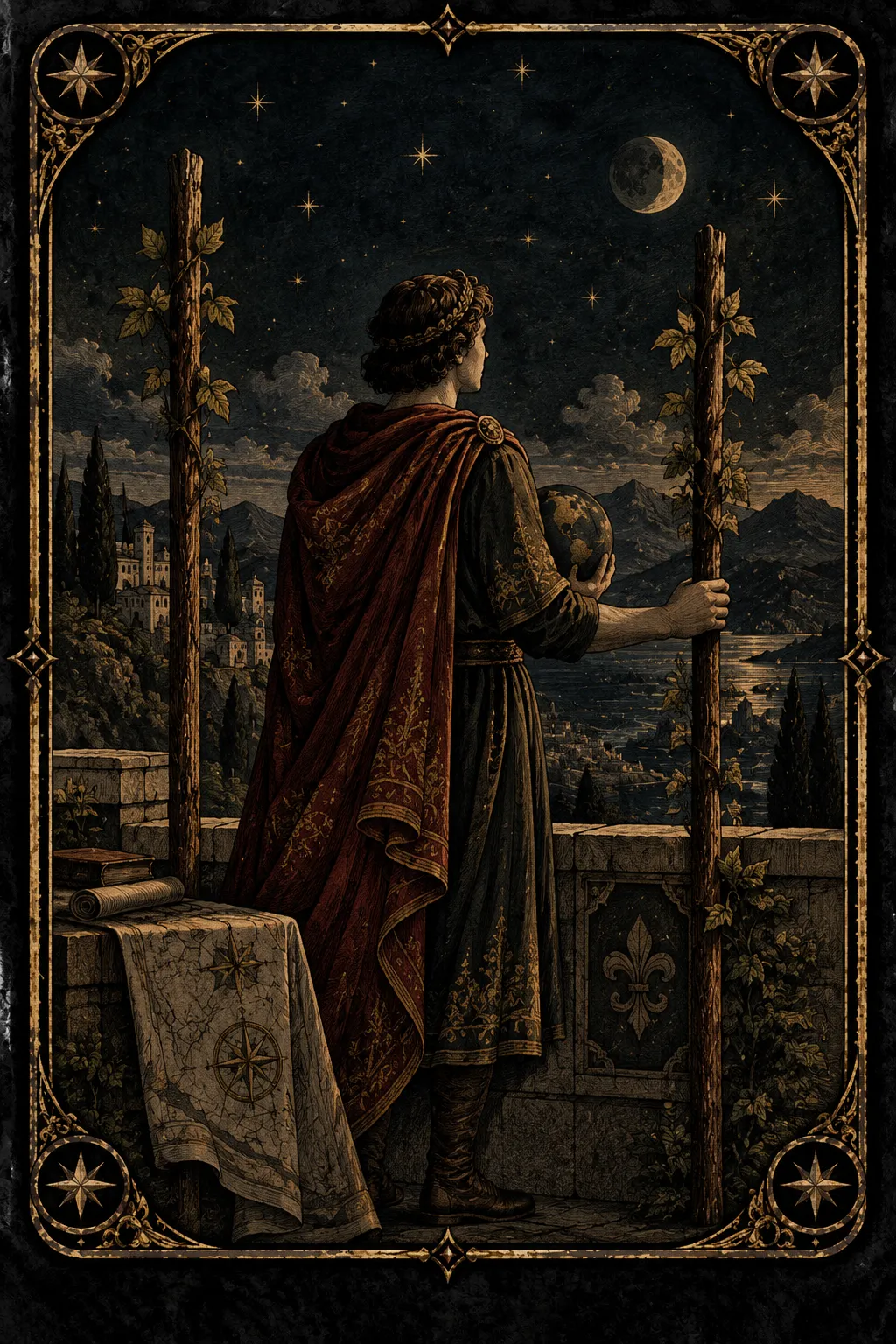
In the classical Rider–Waite image, a figure stands on a castle battlement holding a wand and a globe, looking out over a wide landscape. A second wand is fixed beside the figure.
The scene is traditionally associated with keeping what has already been achieved and choosing where to look next. TARORIA’s drawing does not need to repeat this. In a reading, the choice of horizon matters more than the fortress as a promise of power.
Combinations with other cards
Beside the Chariot, the Two comes under pressure to move faster than a direction has been chosen: useful not to confuse speed with aim. With the Emperor, planning becomes more structural — roles, territory, responsibility for scale. With the Moon, the view ahead is foggy: a fantasy of “out there” is easy to mistake for a real route.
Nearby cards show whether this is a genuine survey or a postponement. Which way to go remains the person’s decision.
Frequently asked questions
Does the Two of Wands mean a move or a journey?
Not necessarily. It is often a choice of direction and a look beyond what has already been reached. A change of place is possible if that is the question. Just as often it is about the next step of a venture or a relationship, not a ticket.
How is it different from the Ace of Wands?
The Ace is the spark to begin. The Two is what to do with an impulse that has already appeared, and with the base you already have: which possibility to choose. One is a start. The other is a direction.
Do I have to drop everything and start something new?
No. The card is often precisely about developing what has already begun, not about refusing it. Look at what is the foundation, and what the next expansion would actually require.
What does the reversed Two of Wands show?
Getting stuck at the current point, a fear of expansion, or many plans without a step. That is not a ban on staying. Ask whether a direction has been chosen, or whether the horizon is only decorating a pause.