Two of Cups — tarot card meaning
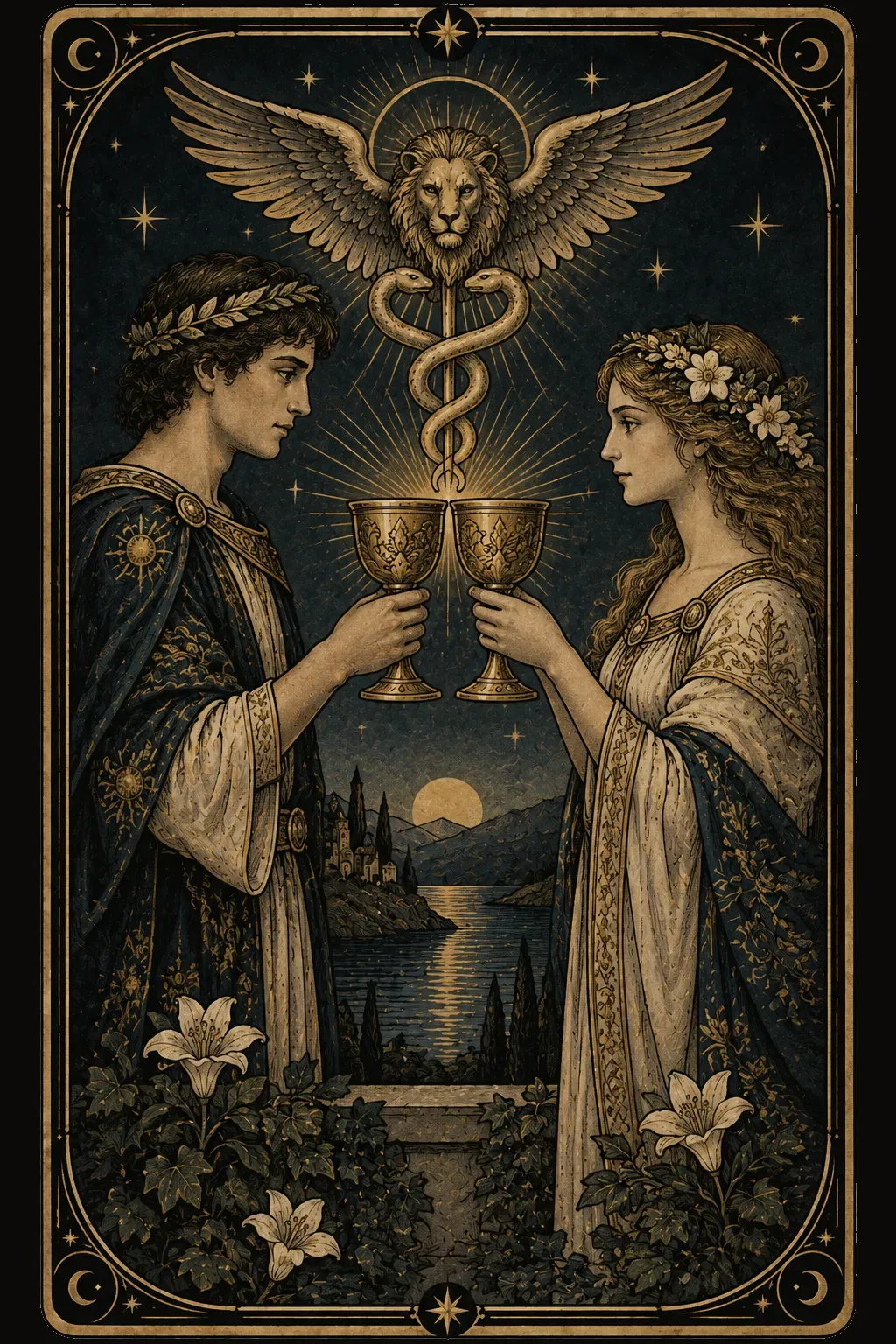
Minor Arcana
Two of Cups
The Two of Cups is about two people. Not a crowd, not abstract infatuation, but a contact in which there is exchange: a look, an agreement, a gesture, an understanding, a mutual interest.
The card is often reduced to an ideal pair. It is more accurate to look at the equality of a meeting. Two people see each other. The question is whether they hear the same thing, and whether they are ready to sustain that exchange without keeping score of who gives more.
General meaning
In the broader picture of a spread, the Two describes reciprocity. It can be a romance, a reconciliation, a partnership, a friendship, a working tandem in which human liking matters. The meaning is in two-way movement, not in one person reaching while the other merely allows themselves to be loved.
Neighboring cards will clarify how stable the exchange is. Sometimes the meeting is fresh and honest. Sometimes a beautiful ritual of agreement covers an unequal contribution.
Upright
Upright more often speaks of a genuine contact between two people. There is a response from both sides, a readiness to agree, warmth that does not have to be begged for. This can be the start of a bond, or a moment when a couple sees each other again after cold.
The upright Two does not promise that the union will last forever. It notes the quality of the meeting: reciprocity, respect, a wish to move toward each other. If the question is whether there is a relationship here, the card is more about an exchange already happening than about a stamp in a passport.
Reversed
Reversed often points to a break in the exchange. One person invests, the other receives. Awkwardness, things left unsaid, attraction without a readiness to be on equal terms. Sometimes the meeting was there, and the rhythms have drifted apart.
The reversed Two does not write the bond off. It asks whether what you call closeness is mutual — and whether you are taking politeness, habit, or convenience for the consent of two people.
Love and relationships
In love this is one of the most direct cards of reciprocity. Upright can describe liking that answers, a readiness to be a pair in simple gestures, a reconciliation when both people take a step. For a new connection — a meeting, not one person’s fantasy.
The card does not promise a wedding. Reversed, it shows one-sidedness, embarrassment that does not turn into clarity, or beautiful words without equal participation. Look at whether there is an exchange — of time, attention, a decision to be near — or whether you are filling in the other person on your own.
Work and career
At work, upright can speak of an alliance of two specialists, an agreement, a human understanding in the pair of you and a colleague, you and a client, you and a project partner. The work rests not only on function, but on respect.
The reversed card notes an unequal contribution, liking that gets in the way of professional boundaries, or an alliance that looks like agreement while one person is pulling. The card does not guarantee a contract. It is useful to check whether the agreement is two-sided in fact.
Money and finances
In finances the Two sometimes touches shared decisions: a budget of two people, an agreement about spending, an exchange of help without humiliation. Upright can describe agreement around money, if both people name the terms.
The card does not promise profit from a partnership. Reversed more often shows that one person pays and the other uses, or that money topics are passed over in silence even though they are what break the reciprocity. It is worth speaking of contribution directly, without replacing it with romance.
Advice
Check whether the other person is in this exchange — not in your head, but in gestures. Reciprocity is visible in an answer, not in the force of your wish.
If the contact is alive, protect the equality: you can be warm without becoming the only one holding the bridge.
Symbolism
In the classical Rider–Waite image, two figures face each other and hold cups toward one another. Above them is a caduceus: two snakes around a staff, often with a winged lion’s head.
Tradition links this scene with a pact of feeling, a handshake of hearts, a meeting on equal terms. The traditional image helps you understand the theme of exchange. It does not claim that TARORIA’s drawing repeats the Rider–Waite deck. In a reading, the gesture toward the other person matters more than the details of the emblem above the heads.
Combinations with other cards
Next to the Lovers, the Two sharpens the choice to be in a bond with awareness, not by the inertia of attraction. With Temperance, the exchange grows calmer: less drama, more proportion. With Justice, reciprocity needs named terms — who gives what, what they expect, where the boundary is.
Neighboring cards show whether this is an honest meeting or a beautiful ritual. The decision to stay in the exchange remains with the people.
Frequently asked questions
Does the Two of Cups promise a relationship?
No. It describes reciprocity and exchange between two people — in love, friendship, collaboration. Upright can support a genuine contact. This is not a guarantee of a union and not a forecast of a wedding.
How is the Two different from the Ace of Cups?
The Ace is the appearance of a feeling or of openness inside. The Two is a meeting of two sides, an answer, an exchange. You can feel strongly on your own. Reciprocity begins when there is a second gesture.
Does the card mean a reconciliation?
It can, if that is the question and both people take a step. Upright describes a readiness to see each other again. Reversed — a break in the exchange. The card does not accomplish a reconciliation for people.
What does the reversed Two of Cups show?
Often one-sidedness, awkwardness, things left unsaid, an unequal contribution. The bond may still be there. Look at whether the other person answers in deeds — or whether reciprocity exists only in your expectation.