Ten of Wands — tarot card meaning
Minor Arcana
Ten of Wands
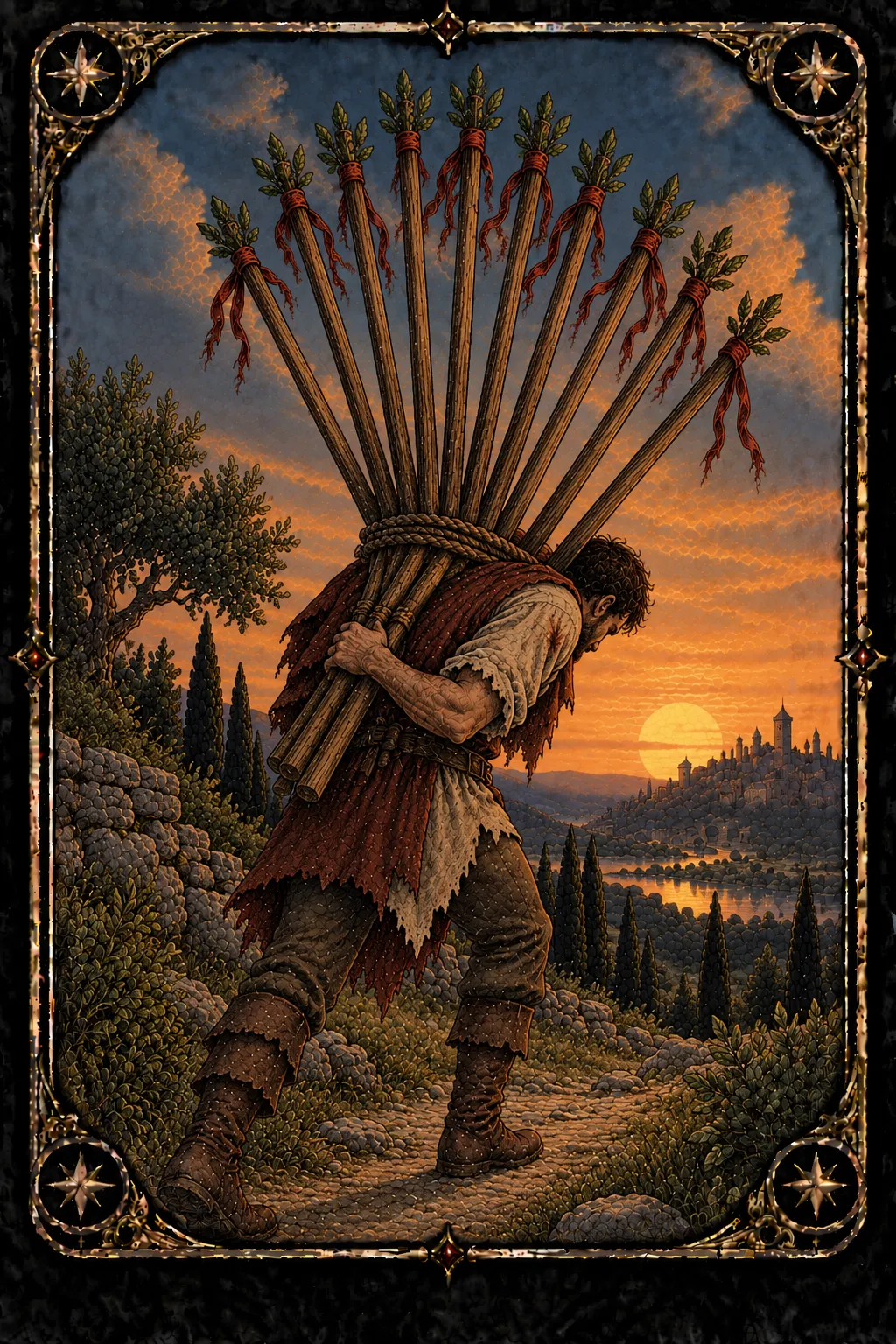
The Ten of Wands is overload. Too much taken on: responsibility, tasks, other people’s expectations, a burden still carried because “who, if not me.”
The card is reduced to success that is heavy to bear. Sometimes that is so. More accurately: you agreed to a load that is already more than you can carry at a sustainable pace. The question is what can be set down.
General meaning
An excess of obligations. The work may genuinely be yours and still be too much. A person is finishing it, stooped. The aim is close, and there is little joy.
Nearby cards show whether this is a chosen burden or an imposed one. The Ten names overload, not the glory of a porter and not a verdict that it will always be this way.
Upright
Upright, the overload is usually obvious. You can see how much is being carried: roles, deadlines, care, projects. A person is still walking. The price shows in breath and in the back.
The card does not romanticize heroics. If you are asking why it is so heavy, it more often describes the amount you have taken on than laziness or weakness.
Reversed
Reversed, the burden is often being released or reassigned. A person may begin to set the extra down. Or they collapse and cannot carry further. Sometimes, on the contrary, they refuse a responsibility that is still theirs.
Instant lightness is not promised. Ask whether you are letting the extra go, or simply falling with the whole heap.
Love and relationships
In love, upright can describe a bond in which one person pulls the household, the emotions, the organizing, the “everything is on me.” That is not a verdict on a couple, and not a victim role by default.
Reversed, an attempt to share the load, or a collapse when you can no longer pretend you are carrying it easily. Whose burden is this, and can it be named out loud? Love does not have to be a constant carrying of the other person.
Work and career
At work this often means too many roles, delegation that does not happen, success that brought still more tasks. Upright describes overload, not a promotion as a reward.
Reversed, giving up or delegating some responsibilities, or a crash. Write out what is truly yours, and what stuck by inertia of “I can, therefore I must.”
Money and finances
In money questions the Ten is obligations: loans, several standing expenses, a need to support others financially. Upright is not wealth through a burden.
It does not promise that the heaviness will pay off. Reversed, a restructuring of obligations, or a refusal to look at the actual amount of a debt. Name how many obligations you are actually carrying. An overloaded budget is not healed by one more responsibility “just in case.”
Advice
Put the load down for a moment and look at how much of it you yourself added yesterday. One thing can be given away, postponed, named as someone else’s.
Finishing what matters is not the same as carrying everything. Heroics that wear you down are no longer service to the work. They are a habit of not asking for help.
Symbolism
In the classical Rider–Waite image, a figure carries ten wands, the head lowered, toward a town in the distance.
The scene is traditionally associated with the burden of a closing stretch of work and with the tiredness of a success that now weighs you down. TARORIA’s card does not need to copy this. In a reading, an excess of what has been taken on matters more than the town as a promise that “a little more and rest.”
Combinations with other cards
Beside the Emperor, a burden easily becomes what the role demands: structure requires, and a person does not check whether this load is actually theirs. With the Hanged Man, another angle is useful: not every responsibility has to hang on one pair of shoulders. With the Four of Wands, the contrast is sharp: a home as a place to breathe out against a home as one more task. The pairing asks whether there is a pause inside the achievement.
Nearby cards show the nature of the load. What to set down remains the person’s decision.
Frequently asked questions
Is the Ten of Wands success that is heavy to carry?
Sometimes yes: a result brought more volume. More often the card is about an overload of obligations in any situation, even without a “win.” Look at what is actually being carried: fame, debt, other people’s tasks, your own habit of grabbing everything.
Do I have to drop everything?
The card does not tell you to quit or leave. It offers seeing the excess and setting part of it down. What to keep is the person’s decision. The heroics of carrying everything are rarely required.
How is it different from the Nine of Wands?
The Nine is wary endurance after experience, a perimeter, a reserve. The Ten is an excessive amount of tasks and roles already taken on. One is armor. The other is a burden. You can be steadfast and still overload the back.
What does the reversed Ten of Wands show?
The beginning of setting the extra down, or a collapse when you can no longer carry. It does not promise lightness at once. Ask whether you are letting part go, or falling with the whole of it.