King of Pentacles — tarot card meaning
Minor Arcana
King of Pentacles
The King of Pentacles is about how resources are managed. The question is not how much money a person has, but how maturely they manage what is already there: people, a budget, property, the long consequences of decisions.
This is not a portrait of a millionaire and not a promise that “money will come.” The King differs from the Nine, from the Ten, and from the Queen. The Nine is personal sufficiency. The Ten is a shared long system. The Queen is care from which a livable environment grows. The King is responsibility for a structure and for the price of decisions.
General meaning
Maturity here is not measured by a bank balance. It is in the horizon: a person understands what a step today will cost in a year. Practicality, competent handling of a resource, a readiness to carry consequences, not only to use the fruits.
Neighboring cards will clarify whether this is genuine management or power through ownership. Sometimes the King provides stability for many. Sometimes status and control replace mastery. The difference is visible not by the throne, but by the quality of decisions.
Upright
Upright is more often about responsibility a person knows how to carry. They manage a resource calmly, count the price, do not confuse a display of wealth with steadiness. Long-term thinking sounds concrete: which obligations are already taken, which cannot yet be carried, who will feel the consequences of this decision.
The upright King supports practicality without greed as the only motive. Competence matters more than a pose. If the question is “who can sustain the structure,” the card describes a mature way of managing — not a crown and not guaranteed success.
Reversed
The reversed King often shifts the center from management to possession. Money and status become ends in themselves. Control through a resource. Inflexibility. Greed. An attempt to look successful with poor handling of practical affairs.
This is not a cartoon villain. A person may be tired, frightened of losing influence, sure that without a hard hand everything will fall apart. The reversed card asks whether the power serves steadiness — or whether steadiness already serves a need to seem the main one.
Love and relationships
In love the upright King shows through a readiness to take part in the real arrangement of a shared life: housing, a budget, decisions, responsibility that can be leaned on. Reliability here is about deeds over the long term. Material provision at the same time does not replace closeness. You can take care of everything materially and remain emotionally unavailable.
Reversed, the card shows how money, property, or status become a tool of control — or the main measure of whether a bond is worth it. A “well-off man” is not someone the card promises. Look at whether a person shares responsibility and the power to decide — or buys the right to set the rules.
Work and career
At work, upright can describe managing a budget, people, the resources of a project, practical decisions with lasting consequences. Business thinking here is not about slogans, but about understanding what the stability of the work is made of.
A leading position is not something the card promises. The reversed King sometimes notes a manager who holds power through control of money, or a specialist who confuses a solid appearance with competence. It is useful to ask who actually makes the decisions and who carries their price — that is not always the same person.
Money and finances
In money questions the King looks at managing what is there: obligations, a horizon, responsibility for other people’s and your own resources. Upright can describe a mature view — not as an investment recommendation, but as a habit of counting consequences.
Wealth is not something the card promises, and it gives no advice on investments. Reversed more often shows a chase after status, control through money, weak handling with a strong wish to seem successful. It makes sense to assess the quality of decisions, not a display of wealth.
Advice
Look not only at how much resource there is, but at how well it is managed. Stability is maintained by decisions, not by display.
If you are in the role of the one who manages, name what your decisions cost other people. If someone else is managing you — ask whose this maturity actually is, and whether you have a voice.
Symbolism
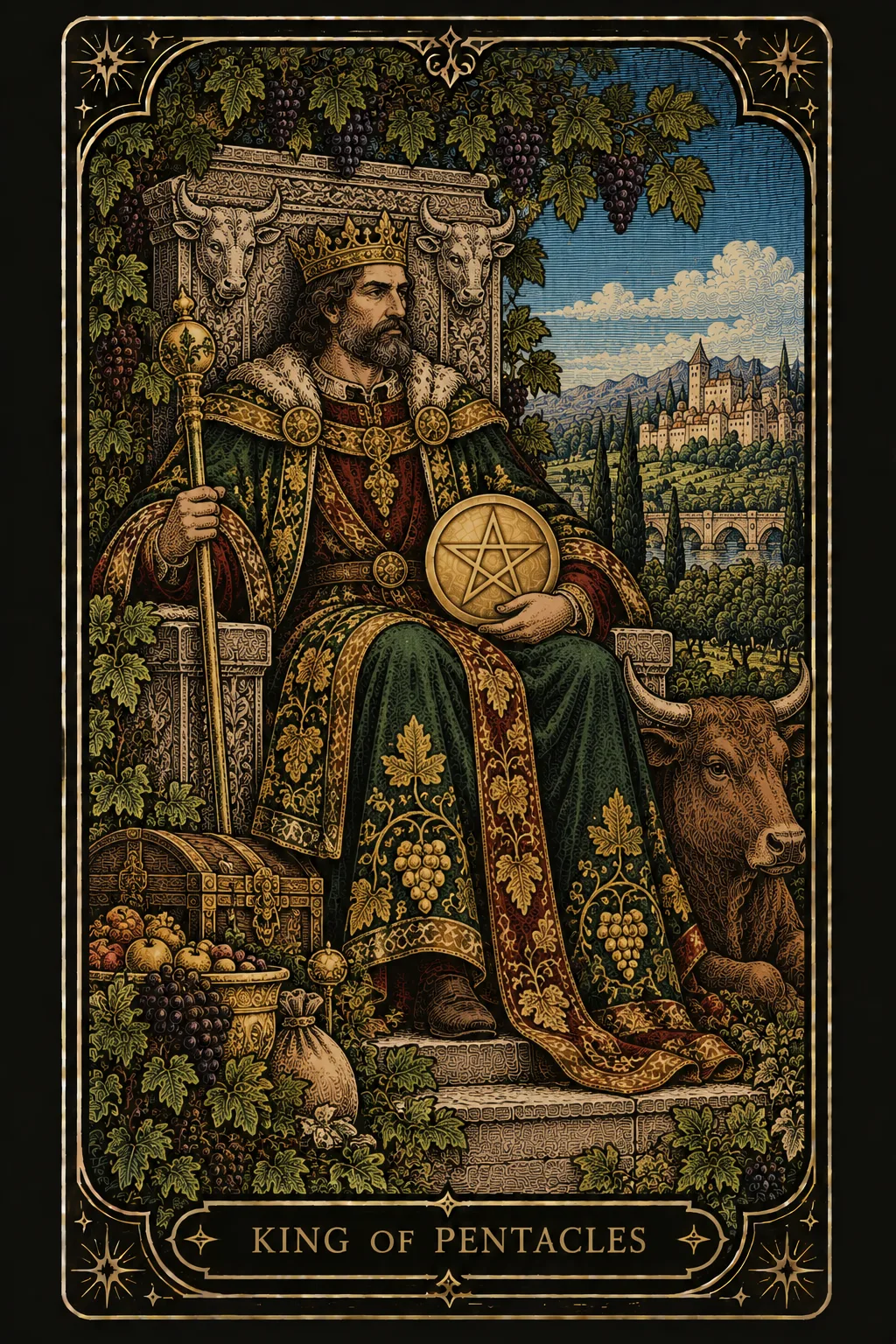
In the classical Rider–Waite image, a seated figure occupies a decorated throne, holding a pentacle and often a scepter. Grapes, vegetation, and stone architecture appear around; bull motifs are often visible in the decoration.
Tradition links this scene with material authority and rootedness: power that rests on earth, property, order. Grapes and stone here are about fertility and the strength of a structure, not about a catalog of luxury. In a reading, how power treats what is within reach matters more than how many ornaments are on the throne. The traditional image explains the theme of managing resources. It does not claim that TARORIA’s drawing copies Rider–Waite.
Combinations with other cards
Next to Judgement, the King gets a theme of honest review: how you actually manage, not how it looks. With the Tower, status and a structure may not hold — then it becomes visible whether the management was genuine, or only an owner’s pose. With the World, the horizon widens: a decision is counted not for a quarter, but as part of a completed cycle of responsibility.
Neighboring cards show whether this is maturity or control through a resource. The assessment of your own decisions remains with the person.
Frequently asked questions
Does the King of Pentacles mean a rich man?
No. Often this is a mature way of managing resources and carrying responsibility — regardless of gender and the size of capital. The card does not promise a well-off partner and does not promise money. Look at the quality of management in your question, not at a display of wealth.
How is the King different from the Nine and Ten of Pentacles?
The Nine is personal independence and sufficiency. The Ten is a shared long system, family, property, continuity. The King is management: decisions, responsibility, structure, the price of steps. You can be sufficient and not know how to lead what is shared. You can live in a stable family and not make mature decisions.
How do I not confuse the King with the Queen of Pentacles?
The Queen creates an environment through care: a household, comfort, practical attention to everyday needs. The King holds the frame of decisions and obligations. In life one person can show both qualities. In a spread, look at the accent of the question: to arrange a life — or to manage a resource and the consequences.
What does the reversed King of Pentacles show?
Often materialism, control through money, status as an end in itself, inflexibility, weak management with a wish to look successful. The card does not require you to see a villain. Ask whether the power serves other people’s stability — or only a need to remain the main one.